

- Posts: 305
- Thank you received: 580
Humberston surprise
- Stuart Britton
- Elite Member
-
![Elite Member]()
Less
More
10 Oct 2021 16:01 #4648
by Stuart Britton
Replied by Stuart Britton on topic Humberston surprise
Thank you Jim. I was only too pleased to get involved in a small way. Contrary to the view of a minority of the LBC membership, ringing plays a very important part of finding out the state of Britain's birds. The results of this project will hopefully be used to determine Government policy on future use of neonicotinoids in agriculture - fingers crossed.
Please Log in to join the conversation.
- Jim Wright
- Topic Author
- Moderator
-
![Moderator]()

Less
More
- Posts: 1870
- Thank you received: 2525
10 Oct 2021 15:02 #4647
by Jim Wright
Replied by Jim Wright on topic Humberston surprise
You couldn't get more thorough than that! Fascinating stuff. Many thanks, Stuart, and hats off to you for your involvement in the project!
Please Log in to join the conversation.
- Stuart Britton
- Elite Member
-
![Elite Member]()
Less
More
- Posts: 305
- Thank you received: 580
10 Oct 2021 09:35 #4644
by Stuart Britton
Replied by Stuart Britton on topic Humberston surprise
Morning Jim, I was involved in a small way in a joint RSPB/BTO project to determine the effects of neonicotinoids on farmland birds. In conjunction with the author I captured a number of farmland birds on plots in Lincolnshire and faecal and blood samples were taken by Rosie Lennon. There are a number of papers on the subject by her - if you Google "The effects of neonicotinoids on farmland bird populations in England" you will find what the conclusions are. It is not very light reading for a Sunday morning!
Please Log in to join the conversation.
- Jim Wright
- Topic Author
- Moderator
-
![Moderator]()
Less
More
- Posts: 1870
- Thank you received: 2525
10 Oct 2021 08:17 #4642
by Jim Wright
Replied by Jim Wright on topic Humberston surprise
Re neonic’s, sounds like an interesting and important piece of research, Stuart. Who commissioned it? What were the conclusions? Is the info publicly available or is it confidential?On the wider issue, I don’t criticise farming practices. I understand the need to be competitive and efficient to feed an ever-expanding global population.The trouble is that new insecticides, herbicides and fungicides - politely described as ‘plant protection products’- are being launched all the time.In one way or another, their purpose is to interfere with the Balance of Nature - and farmland birds (skylarks, buntings, grey partridge etc) are among the chief casualties.
The following user(s) said Thank You: Peter Wood
Please Log in to join the conversation.
- Stuart Britton
- Elite Member
-
![Elite Member]()
Less
More
- Posts: 305
- Thank you received: 580
08 Oct 2021 18:31 #4632
by Stuart Britton
Replied by Stuart Britton on topic Humberston surprise
Jim, a little surprised at your not too veiled criticism of farm practices in Lincolnshire. Having been involved in monitoring the effects of neonicotinoids on birds on Lincolnshire farmland birds, I think you might be surprised at the effort taking to avoid adverse effects on birds by chemical sprays - many have been banned.
The following user(s) said Thank You: Pete Locking
Please Log in to join the conversation.
- Jim Wright
- Topic Author
- Moderator
-
![Moderator]()
Less
More
- Posts: 1870
- Thank you received: 2525
08 Oct 2021 16:05 - 08 Oct 2021 18:27 #4627
by Jim Wright
Humberston surprise was created by Jim Wright
Just as I was lamenting an almost total absence of birds on farmland after cropfield spraying, I encountered a magnificent brambling perched on an elder bush. This at 2.55pm today at the bottom of South Sea Lane where the cars park. (It's definitely in the photo somewhere - magnifying glass may be needed!)
In fairness, I did also see three stock doves feeding on a ploughed field until they exploded into flight. Unshowy, but one of my favourite species which seldom makes the headlines on the Forum.
In fairness, I did also see three stock doves feeding on a ploughed field until they exploded into flight. Unshowy, but one of my favourite species which seldom makes the headlines on the Forum.
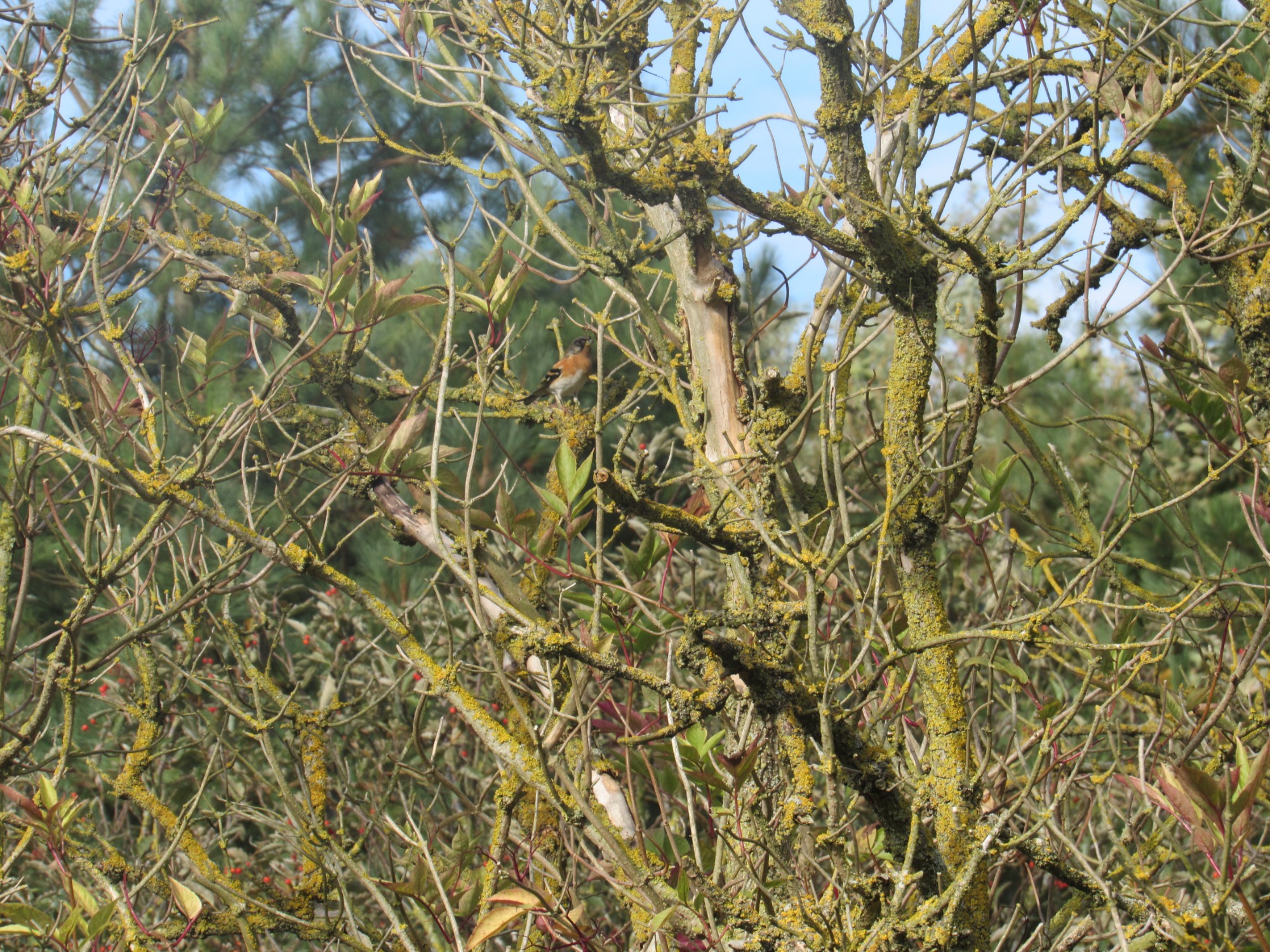
Last edit: 08 Oct 2021 18:27 by Jim Wright.
Please Log in to join the conversation.
About Us
We are the Lincolnshire Bird Club. Our aims are to encourage and further the interest in the birdlife of the historic County of Lincolnshire; to participate in organised fieldwork activities; to collect and publish information on bird movements, behaviour, distribution and populations; to encourage conservation of the wildlife of the County and to provide sound information on which conservation policies can be based.